Here is Fr. Tim’s Christmas homily which contains a powerful message about darkness and light at the time of God entering our world as a man 2000 years ago and as we strive to hold onto the Light amid the darkness we encounter today. As we close 2018, let’s honor God and ourselves by spending a few quiet moments pondering Fr. Tim’s words, resolving to spread the Good News in words and deeds during the New Year.
+++++
MSGR. SHUGRUE’S CHRISTMAS HOMILY
We gather once again in the darkness to celebrate the Birth in time of the Light of the World. It is always an apt metaphor for Christmas, the contrast between Darkness and Light, but this year it is particularly so for the Catholic Community in our country and around the world, as we struggle with the pain of widespread reports of sexual abuse of minors and others perpetrated by members of the clergy, and of misguided methods of bishops in dealing with accounts of abuse.
We cannot approach the tenderness and warmth of the Christmas story without being acutely conscious of the ongoing trauma, the bitter disillusionment, the wounded trust of victims of this abuse. We cannot ignore the cries for justice and for reforms. But we can approach with humility, standing alongside those who come, like the shepherds, out of the cold and the dark, in the hope of having spirits lifted and reassured by the simplicity and directness of the Christmas message: that there is One among us now who understands, from inside our human experience of vulnerability, of pain, of rejection.
The Word Made Flesh lies before us–God not just telling us from afar that He cares, but here with us, to be the physical expression of God’s care. The visible tears and invisible bruises of our brothers and sisters remind us that we are all vulnerable—and Jesus embraced that vulnerability from the first moment of His earthly life. His would be a life that met contradiction and resistance to the very end: what makes it salvific for us is that it was freely embraced, out of love–love for His Father, and love for us, fulfilling His Father’s promise to come to our rescue because we were incapable of saving ourselves from the consequences of our first parents’ sin of arrogant disobedience. That template of all human sin–placing oneself at the center of reality, trying to bend others to our will, using people, exploiting them, caring for oneself first–that has been replicated innumerable times: it is the habit of the disordered human will, and none of us are immune to its seductive lure.
But at Christmas we see a challenge to that very sorry image of humanity trying to exalt itself as the Supreme Being. The Word Made Flesh entered into the world in poverty, a stranger in Bethlehem, turned away from every door, deprived of welcome except among the animals in a stable. The circumstances are eerily familiar, visible to us today when refugees and desperate migrants present themselves before the doors of those fortunate enough to be already in places of security and plenty.
I met a woman not long ago who told me that her daughter was a successful country-western singer, and while listening to the Psalm Response for yesterday’s Fourth Sunday of Advent, I thought about a country-western song you also may recall. The Psalm prayed, “Lord, make us turn to you. Let us see your face and we shall be saved.” The country-western song, a lament over disappointed relationships, is all about “looking for love in all the wrong places, looking for love in all the wrong faces.”
Now we do see the face of God, and He looks like one of us. And we see love—the love of a Child who knows only how to give, not to take—a Child Who came trustingly into this world, and Whose love did not falter, even when His trust was met with opposition, ridicule, resentment, an unjust trial and execution. The Child, Love incarnate, God’s eternal Love, in the flesh, before our eyes, wordlessly looks back at us, inviting us to see in Him from the very beginning, and with every step forward, that this is how being human is supposed to be done. THIS is what it means to be a child of God.
He invites us anew each anniversary of His birth to take up again His call to follow Him in the pattern of compassionate, forgiving love that was and is the core of His identity–to pursue integrity and justice in all our relationships, to embrace truth and purity, to forego anger and suspicion as the basis for living in human society. It is not an easy path to follow, Jesus says, at the very start of His mission as our Messiah, the One anointed to be the Savior of humankind.
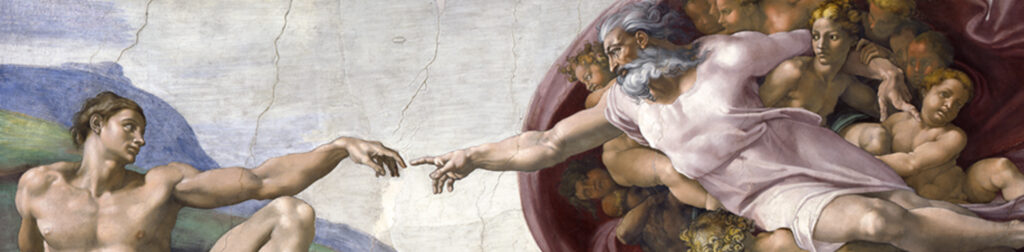
“But you will not be alone on the path: I am forever your companion and model. Take my hand. Walk with me.” Jesus says.
With reference to the discouraging mood cast by the recent scandals, Fr. Philip Bochanski has written:
“. . . it is precisely in our faith in the Incarnation, in the mystery of God-with-us, the Word Made Flesh, that we find our surest hope of understanding, facing and healing the mystery of sin.
In His great love for us, God the Son did not skip a single moment of human life, from conception to death, and not a single human experience escapes His attention. He took on a real human nature, a real human body and soul, loved with a real human heart, in real human relationships, in a real human family. In His earthly life He sanctified human life itself, making every moment of our daily lives an opportunity to imitate Him and to grow in His likeness. In His public ministry, He healed every wound, soothed every pain and suffering, of those who put their faith in Him. In His Passion, Death and Resurrection, He paid the price for those who fail to imitate Him, and saved us from sin and death itself.
As we . . . celebrate the Nativity of the Lord, let us unite to pray even more fervently than before for all survivors of abuse, for the repentance of those who have abused and for the purification and conversion and healing that will allow the Church to make Christ more visible in the world.”
For the Child Jesus, the One Whom we celebrate with light and song and solemn but unrestrained joy, grew up to be a man, and suffered and died for us, the Lamb of God Who willingly sacrificed Himself for us. We believe that He rose from the dead and returned to His Father. But He didn’t abandon us, like a figure locked permanently in the world of 2,000 years ago. In concluding nearly every prayer, we affirm that He lives, and reigns with the Father and the Holy Spirit. That doesn’t mean that Jesus lives only in a far-away heaven: He lives here, in our world, in our homes and families, in our neighborhoods, our town, our state, our country. He lives in us. And we stay connected with Him through the Church rooted in the real Jesus of Nazareth. He is the One Who binds us together in our desire to do God’s will. As we approach the Christmas tableau this year, conscious of the hurt among us at failures within the Church, we see a response in the eyes of the Child in the manger. “I know”, those eyes tell us; “I know what you are going through.” From that assurance we draw hope and a reason to celebrate, and resolve to commit ourselves to continue walking together with Him and with one another, for the sake of our world.